Category: Blog

Your blog category

  • Why European Automotive OEMs Now Mandate Certified Recycled Polyester Staple Fiber for Car Seating

    Why European Automotive OEMs Now Mandate Certified Recycled Polyester Staple Fiber for Car Seating

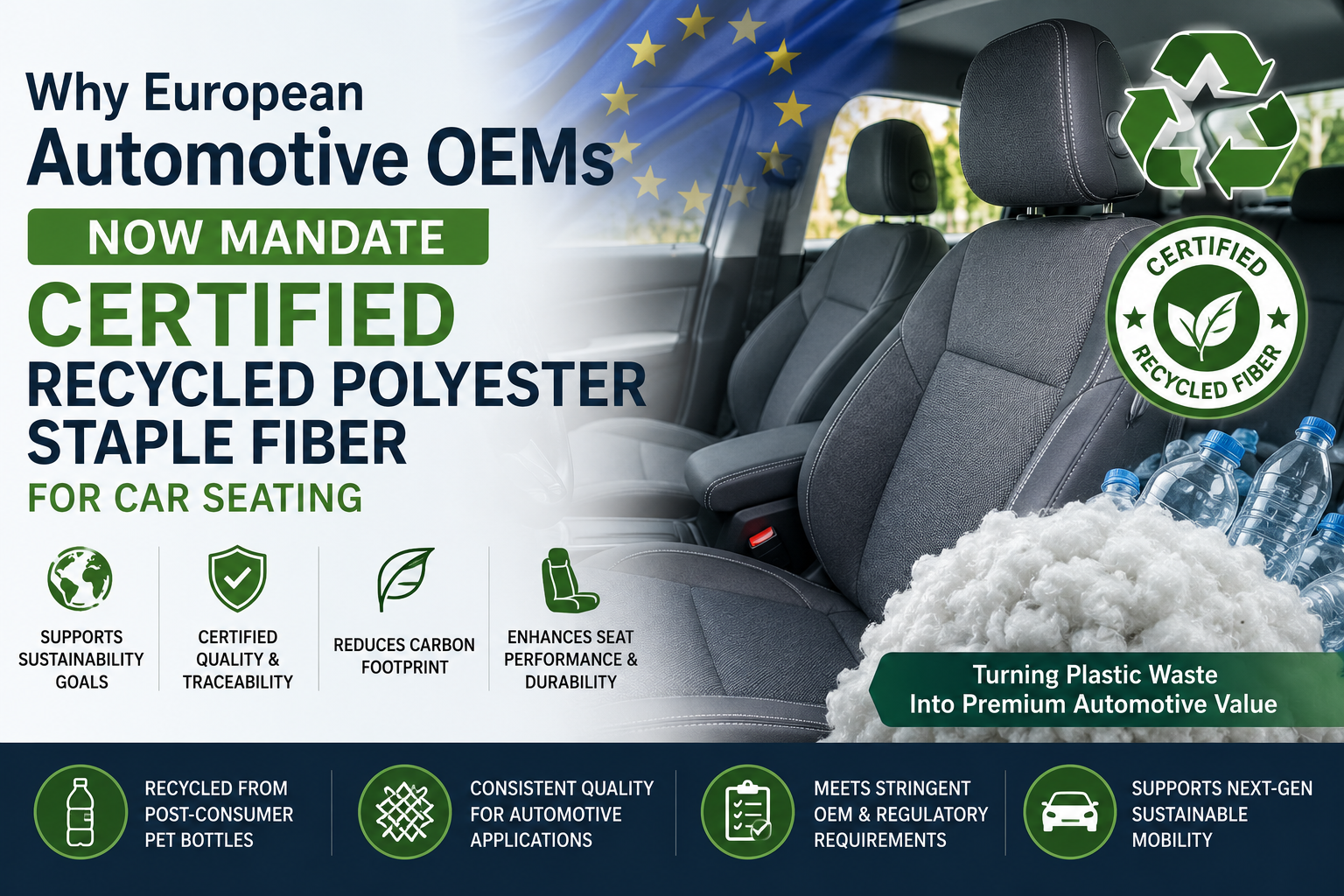
    The European automotive sector is moving rapidly towards sustainable manufacturing and Certified Recycled Polyester Staple Fiber (RPSF) is being favoured for vehicle seating systems. OEMs are increasingly demanding certified recycled materials throughout their supply chains, driven by stricter environmental regulations, carbon reduction targets, and the increasing consumer demand for green vehicles.

    Today, certified recycled polyester staple fiber is helping manufactures achieve sustainability goals, while delivering exceptional durability, comfort and performance in automotive seating applications. That is why certified RPSF is now a must-have material for modern vehicle interiors for European automotive OEMs.

    The Search for Sustainable Car Production

    Europe has emerged as a global leader in sustainable mobility. European Green Deal, Circular Economy Action Plan and End-of-Life Vehicle (ELV) directives all include legislation that encourages the automotive manufacturers to use more recycled materials and lessen their reliance on virgin materials.

    As a result, vehicle manufacturers are redesigning interiors with environmentally friendly materials that provide premium quality and durable longevity. Certified recycled polyester staple fiber delivers these goals precisely by converting post-consumer PET bottles into high-performance fibers for automotive applications.

    RPSF Certified Ensures Uniform Material Quality

    Automakers must be absolutely consistent from one production run to the next. Certified recycled polyester staple fiber is tested to strict quality standards to ensure uniform fiber length, tensile strength, resilience and cleanliness.

    The certification gives OEMs confidence that the material has been tested to international standards of quality and will hold up to the rigors of automotive use.

    In addition, the use of certified materials enhances transparency in the supply chain and supports manufacturers in meeting sustainability reporting standards.

    Outstanding Durability for Vehicle Seating

    Car seats are under pressure, friction and continual use throughout the life of the vehicle. The durable, recycled polyester staple fiber helps seating systems retain their shape and structural integrity after years of everyday use.

    Its great resilience enhances:

    • Recovery from cushions
    • Seating comfort
    • Dimensional stability.
    • Long-term results

    This durability contributes to customer satisfaction and a decrease in warranty claims for manufacturers.

    Lightweight Materials Enhance Vehicle Efficiency

    In automotive engineering, weight reduction is still one of the main goals, especially in electric cars, where it directly translates to the range of the vehicle.

    Recycled polyester staple fiber offers an excellent strength-to-weight ratio and enables manufacturers to develop lightweight seat cushions and interior parts without sacrificing durability.

    Reduced vehicle weight results in:

    • Improved mileage
    • More EV battery range
    • Lower carbon emissions
    • Improved overall vehicle performance
    • Improved passenger comfort

    Today, the need for premium comfort in the interior of a car is the same for short or long distances.

    Recycled polyester staple fiber has excellent cushioning, breathability and recovery characteristics which improve seating comfort. Its fiber structure keeps it soft but doesn’t allow too much compression over time.

    These properties make certified RPSF suitable for:

    • Seats for passengers
    • Head-rests
    • Armrests
    • Acoustic insulation Interior padding Supports Circular Economy Goals

    One of the main benefits of recycled polyester staple fiber is that it helps in the circular economy.

    Millions of discarded PET bottles can be turned into high quality automotive-grade fibers instead of ending up in landfills or oceans.

    Automobile manufacturers reduce with the incorporation of certified recycled materials:

    • Plastic trash
    • Virgin polyester use
    • Depletion of Natural Resources
    • Emissions of greenhouse gases

    This is in line with Europe’s long-term sustainability goals and at the same time delivering tangible environmental benefits.

    Sustainability and ESG Standards Compliance

    Automotive brands are increasingly being evaluated by investors, regulators and consumers on their Environmental, Social and Governance (ESG) performance.

    The use of certified recycled polyester staple fiber helps manufacturers to improve their ESG reporting by demonstrating responsible sourcing, recycled material use and reduced environmental impact.

    Certification standards like the Global Recycled Standard (GRS) offer traceability along the entire production process, making sustainability claims credible.

    Better Interior Performance

    In addition to sustainability, certified recycled polyester staple fiber offers technical advantages.

    It offers:

    • Good resistance to moisture
    • Thermal insulator
    • Sound reduction
    • Resistance to chemicals
    • Long lasting dimensional stability

    These properties improve overall interior performance and aid in supporting premium vehicle quality.

    Increasing Consumer Demand for Sustainable Vehicles

    Nowadays, car buyers are more and more interested in cars made from environmentally friendly materials.

    Recycled materials are now a big focus for many premium automotive brands as part of their sustainability drive. Vehicle interiors made with certified recycled polyester fibers show a brand’s dedication to responsible manufacturing, while also fulfilling customer expectations for quality and comfort.

    With people becoming more aware of the environment, the use of sustainable materials for interiors is becoming an important competitive advantage.

    How to Choose the Best Certified RPSF Maker

    Automotive applications: Choosing a reliable recycled polyester staple fiber manufacturer is crucial.

    Manufacturers should provide:

    • Recycled raw material, certified
    • Uniformity of fiber quality
    • Advanced manufacturing technology
    • International quality certifications
    • Secure global supply capability

    Automotive OEMs can be assured that a partnership with an experienced supplier will deliver materials that meet rigorous industry specifications.

    Also Read: How recycled polyester staple fiber improves product performance

    Certified Recycled Polyester Staple Fiber is a strategic material for European automotive OEMs looking to combine sustainability with outstanding product performance. Its durability, light weight, comfort, thermal properties and environmental benefits make it an ideal choice for modern vehicle seating systems.

    As regulations tighten and consumer expectations evolve, certified recycled polyester staple fiber will have an even bigger role to play in the future of sustainable automotive manufacturing. Automotive brands that invest in high quality certified RPSF will be better positioned to meet tomorrow’s environmental standards while delivering superior comfort, safety and performance.
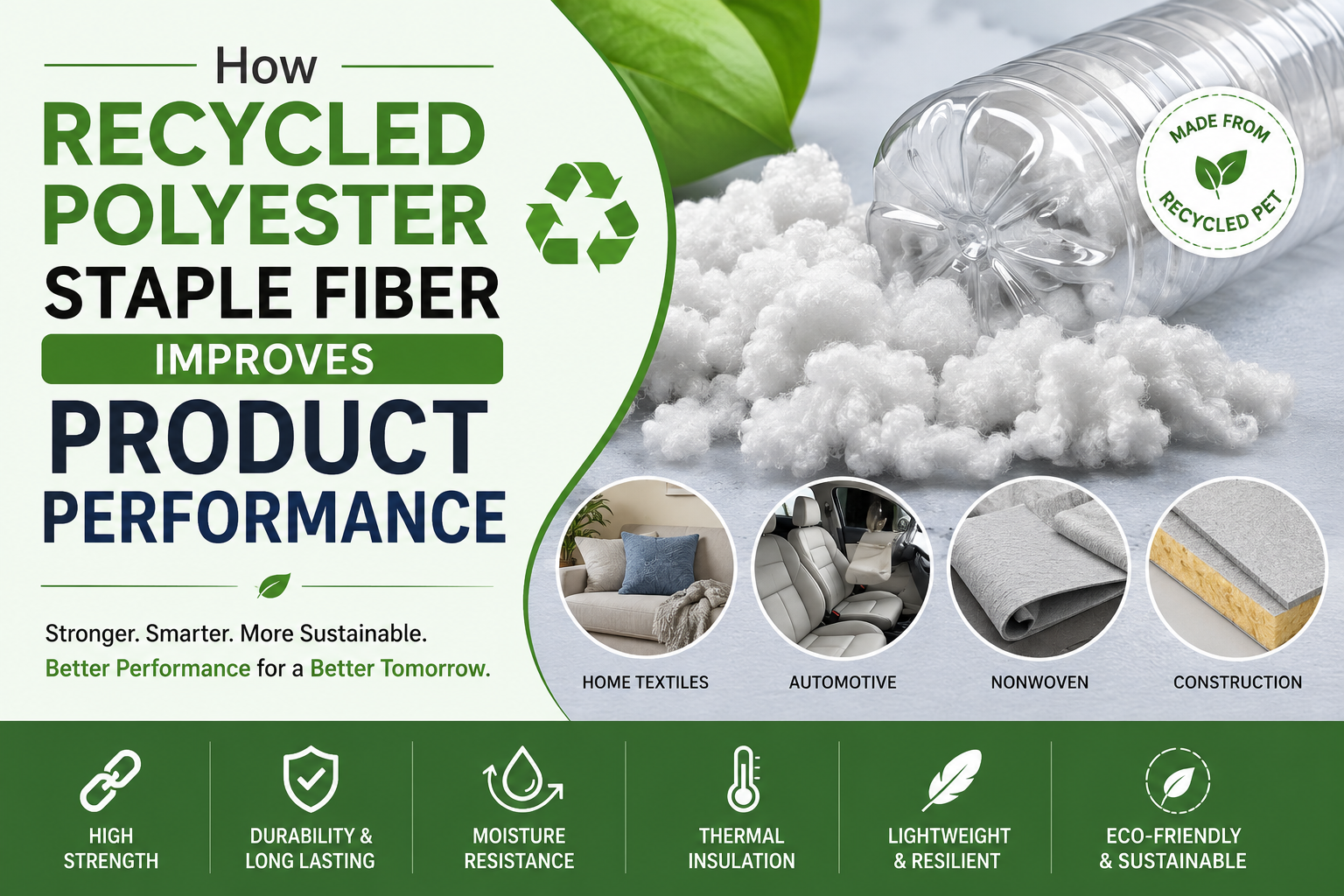
  • How Recycled Polyester Staple Fiber Improves Product Performance

    How Recycled Polyester Staple Fiber Improves Product Performance

    Sustainability is more of a priority for industries and manufacturers are looking for a material that provides both environmental benefits and increased product quality. One material that has received a great deal of attention is Recycled Polyester Staple Fiber (RPSF). Made from recycled PET bottles and post-consumer plastic waste, RPSF offers exceptional durability, strength and versatility, while enabling circular manufacturing practices.

    Today, recycled polyester staple fiber is used in industries such as textiles, automotive, home furnishings, construction, and nonwoven manufacturing to improve product performance without sacrificing quality. This sustainable material makes products perform better – here’s why.

    Superior Strength & Durability

    One of the most important reasons why manufacturers opt for recycled polyester staple fiber is its very high strength. Finished products made with high-quality RPSF have superior tensile strength, which makes them more resistant to wear and tear.

    Recycled polyester staple fibre is used in upholstery fabrics, geotextiles, insulation materials and automotive interiors to help products retain their structure and performance over time. That means products last longer and you pay less to replace them.

    Good shape retention

    The products made of recycled polyester staple fiber keep the original shape after repeated use. The excellent resilience of the fiber allows cushions, pillows, mattresses and furniture fillings to recover rapidly after compression.

    This makes RPSF an ideal choice for manufacturers seeking to enhance product comfort while sustaining long term performance.

    Great Moisture Resistance

    Recycled polyester staple fiber absorbs very little moisture, unlike natural fibers. This property allows products to dry quickly and resist mildew, mold and bacterial growth.

    Moisture resistance is especially useful for applications such as:

    • House textiles
    • Patio Furniture
    • Automotive Interior
    • Technical fabrics
    • Nonwovens

    Products are therefore cleaner, more durable and easier to maintain.

    Light & Strong

    Recycled polyester staple fiber has an excellent strength-to-weight ratio. This allows manufacturers to produce light products without compromising on strength or structural integrity.

    This benefit is especially valuable in industries where weight reduction improves efficiency, including automotive, luggage, footwear and industrial packaging.

    Improved Thermal Insulation

    The air trapped in the fiber structure provides RPSF with good thermal insulation. This makes it a preferred material for insulation products, quilts, jackets, sleeping bags and construction applications.

    Better insulation not only improves comfort for users, but also helps buildings and consumer products to be more energy efficient.

    Enhanced Product Consistency

    The modern recycling technology ensures that the high quality recycled polyester staple fiber is consistent in fiber length, denier and strength from one production batch to the other.

    This consistency helps producers:

    • Boost production efficiency
    • Minimize material waste
    • Deliver consistent product quality
    • reduce manufacturing defects

    In the end reliable raw materials mean better performing end products.

    Excellent mixing ability

    Recycled polyester staple fiber blends easily with cotton, viscose, wool, acrylic and other synthetic fibers. This flexibility allows manufacturers to develop fabrics with customized performance properties such as softness, strength, elasticity, and durability.

    Mixed fibres are widely used in apparel, household textiles, industrial fabrics and technical applications.

    Chemical and Abrasion Resistance

    Products made from recycled polyester staple fiber are highly resistant to chemicals, abrasion and environmental exposure.

    This makes RPSF suitable for demanding industrial applications like:

    • Geotextiles
    • Filter media
    • Industrial Textiles
    • The protective material
    • Construction products

    The increased resistance extends the life of the product even under harsh operating conditions.

    Encourages Sustainable Manufacturing

    In addition to performance benefits, recycled polyester staple fiber helps manufacturers reduce their environmental footprint.

    Manufacturers turn PET plastic bottles into high quality fibers and can:

    • Minimize landfill waste
    • Less reliance on virgin polyester
    • Protect natural resources
    • Lower carbon emissions
    • Support circular economy activities

    Many global brands use recycled materials to meet their sustainability goals, but still maintain the quality of their products at a premium.

    Performance Solution. Lower cost.

    Recycled polyester staple fiber offers manufacturers the ideal blend of performance and cost-effectiveness. RPSF offers excellent mechanical properties at a competitive cost to many other man-made fibers.

    Its durability also cuts down on maintenance and replacement costs, making it a smart long-term investment for manufacturers in multiple industries.

    Also Read: Why 60% of fashion brands are switching to recycled polyester staple fiber in 2026

    Recycled polyester staple fiber has evolved from an environmentally friendly alternative to a high-performance material used by manufacturers around the world. It is strong and light, moisture resistant, thermally insulating, durable and uniform in quality and is useful for millions of industrial and consumer applications.

    With sustainability increasingly taking hold in global manufacturing at an ever faster pace, businesses using recycled polyester staple fiber can boost product performance and lessen their environmental impact. Collaborating with an experienced Recycled Polyester Staple Fiber manufacturer allows you to avail the best quality fibers that follow worldwide standards and help in making strong, creative, and green products.

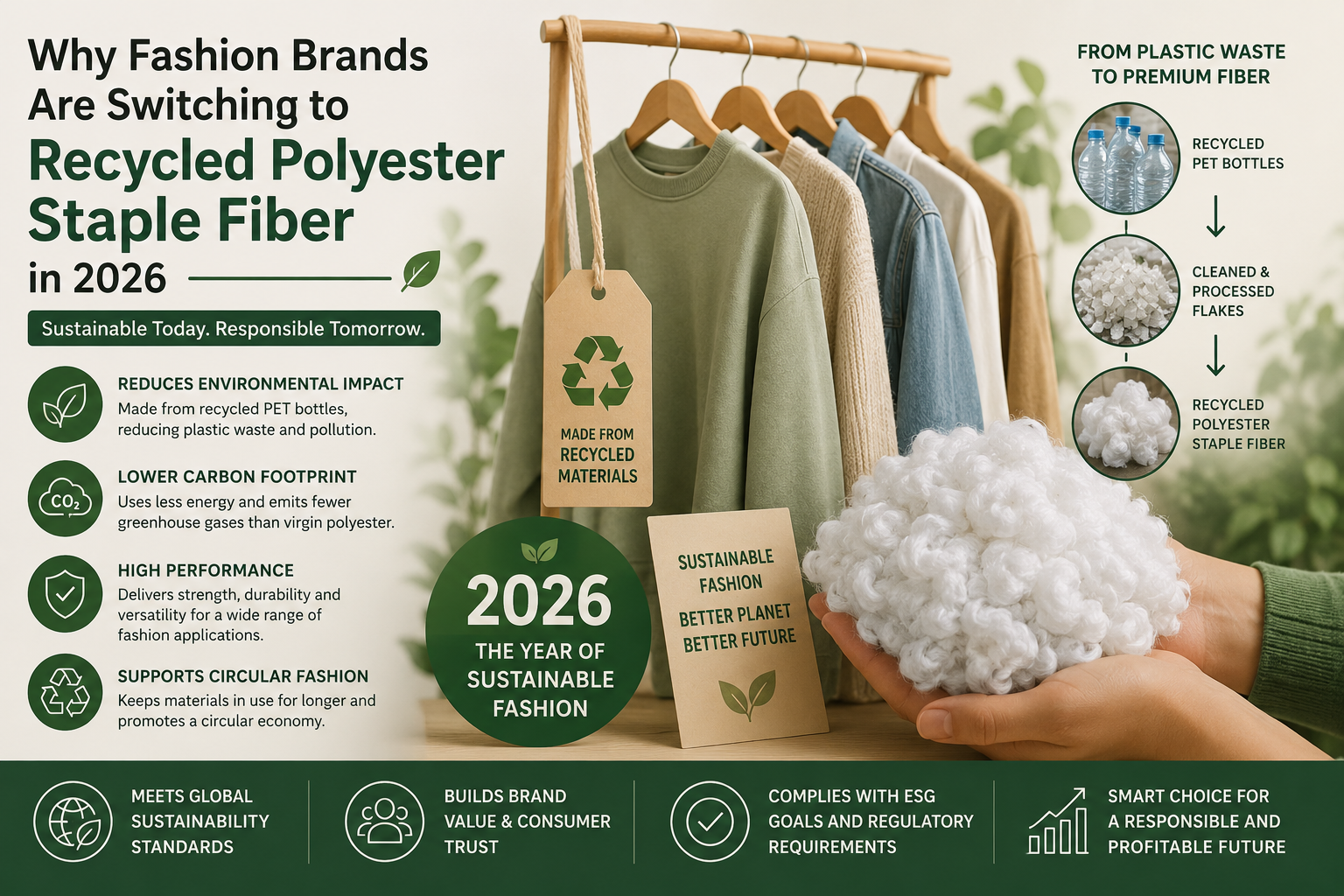
  • Why 60% of Fashion Brands are Switching to Recycled Polyester Staple Fiber in 2026

    Why 60% of Fashion Brands are Switching to Recycled Polyester Staple Fiber in 2026

    Sustainability is a top priority for both brands and consumers and the fashion industry is changing dramatically. As environmental concerns grow, regulations tighten and consumers increasingly demand green products, manufacturers are rethinking their sourcing strategies. One of the materials behind this change is Recycled Polyester Staple Fiber (RPSF).

    Many fashion brands are expected to increase their use of recycled polyester by 2026 as part of their sustainability pledges. From sportswear and casual apparel to home textiles and fashion accessories, RPSF is becoming a key material for brands that want to balance performance and environmental responsibility.

    The Shift to Sustainable Fashion

    Today’s consumers are more aware of the environmental impact of the clothes they buy. Many consumers are actively seeking out products made from recycled or sustainable materials, incentivizing brands to adopt greener manufacturing methods.

    Recycled Polyester Staple Fiber is made from post-consumer PET bottles and recycled polyester waste. Plastic waste no longer needs to be sent to landfills because it can be converted to a high quality fiber that can be used in a variety of textile applications.

    This process reduces plastic pollution and promotes a circular economy where valuable materials are kept in use longer.

    Environmental Impact Reduced

    One of the primary reasons for fashion brands to adopt RPSF is its significantly lower environmental impact compared to virgin polyester.

    The manufacture of recycled polyester usually requires fewer natural resources and less energy. It also reduces dependence on petroleum-based raw materials and cuts emissions of greenhouse gases related to fiber production.

    For brands on their journey to carbon reduction targets, recycled polyester is a practical, no-compromise solution for product performance.

    Achieving Global Sustainability Goals

    Many international fashion brands have made ambitious sustainability pledges for the years to come. Often these goals include increasing the percentage of recycled materials used in their products

    Brands may utilize Recycled Polyester Staple Fiber to support their environmental programs, corporate ESG strategies and responsible sourcing policies. It also demonstrates a commitment to sustainable manufacturing which is becoming increasingly important to investors, retailers and customers.

    High Performance for Today’s Textiles

    Sustainability is just one side of the coin. Fashion brands also need materials that provide consistent quality and durability.

    Modern recycling technologies allow manufacturers to produce RPSF with excellent strength, softness, resilience and processing performance. Recycled fibers can be used for apparel, jackets, sportswear, insulation, nonwovens and home furnishings depending on the application.

    Recycling processes have been continuously optimized and high quality recycled polyester can be used for demanding textile applications.

    Supporting Circular Fashion

    Circular fashion is about keeping materials in use for as long as possible, through recycling and ethical manufacturing.

    Recycling each PET bottle into polyester staple fiber reduces waste and creates valuable raw material for future products. Fashion companies can help to create a more sustainable supply chain by adding recycled fibers to their collections, rather than using virgin resources only.

    This strategy boosts resource efficiency across the textile industry and contributes to achieving long-term environmental goals.

    Meeting Consumer Expectations

    Today’s consumers are looking beyond style and price. Transparency, responsibly sourced and environmentally conscious production are more and more appreciated.

    Fashion brands that incorporate recycled materials into their products can increase customer trust and boost their brand image. Many retailers now feature recycled fiber content as an important product attribute to help consumers make more informed purchasing decisions.

    Sustainability is affecting buying behavior, and recycled polyester is becoming a competitive advantage and not just an alternative material.

    Advanced Recycling for a reliable supply

    India and several other countries have built up their recycling infrastructure enormously in recent years. High-quality recycled polyester is becoming more available thanks to better PET bottle collection systems, better sorting technologies and better fiber manufacturing processes.

    Availability of reliable raw material allows RPSF manufacturers to consistently provide fibers to the textile producers that meet international quality requirements.

    The constant flow of goods is meeting the needs of growing international fashion brands.

    THE FUTURE OF FASHION PRODUCTION

    The textile industry is on its way to more intelligent, cleaner and more sustainable production methods. “Recycled polyester staple fiber will continue to be ever more important as brands strive to reduce waste, improve resource efficiency and meet changing environmental standards.”

    With the rapid progress in recycling technology and growing consumer awareness, RPSF is set to become a preferred raw material in multiple segments of fashion.

      Also Read: What is EPR for plastics in india how recycled polyester staple fiber manufacturers benefit

    The increasing popularity of Recycled Polyester Staple Fiber is proof of the fashion industry’s commitment to sustainable innovation. This change is being driven by lower environmental impact, reliable performance, improved recycling systems and changing consumer expectations.

    As more brands adopt responsible manufacturing practices in 2026 and beyond, Recycled Polyester Staple Fiber will continue to be an important material in driving the future of sustainable fashion and helping to build a cleaner, more circular textile industry.

  • What is EPR for Plastics in India? How Recycled Polyester Staple Fiber Manufacturers Benefit

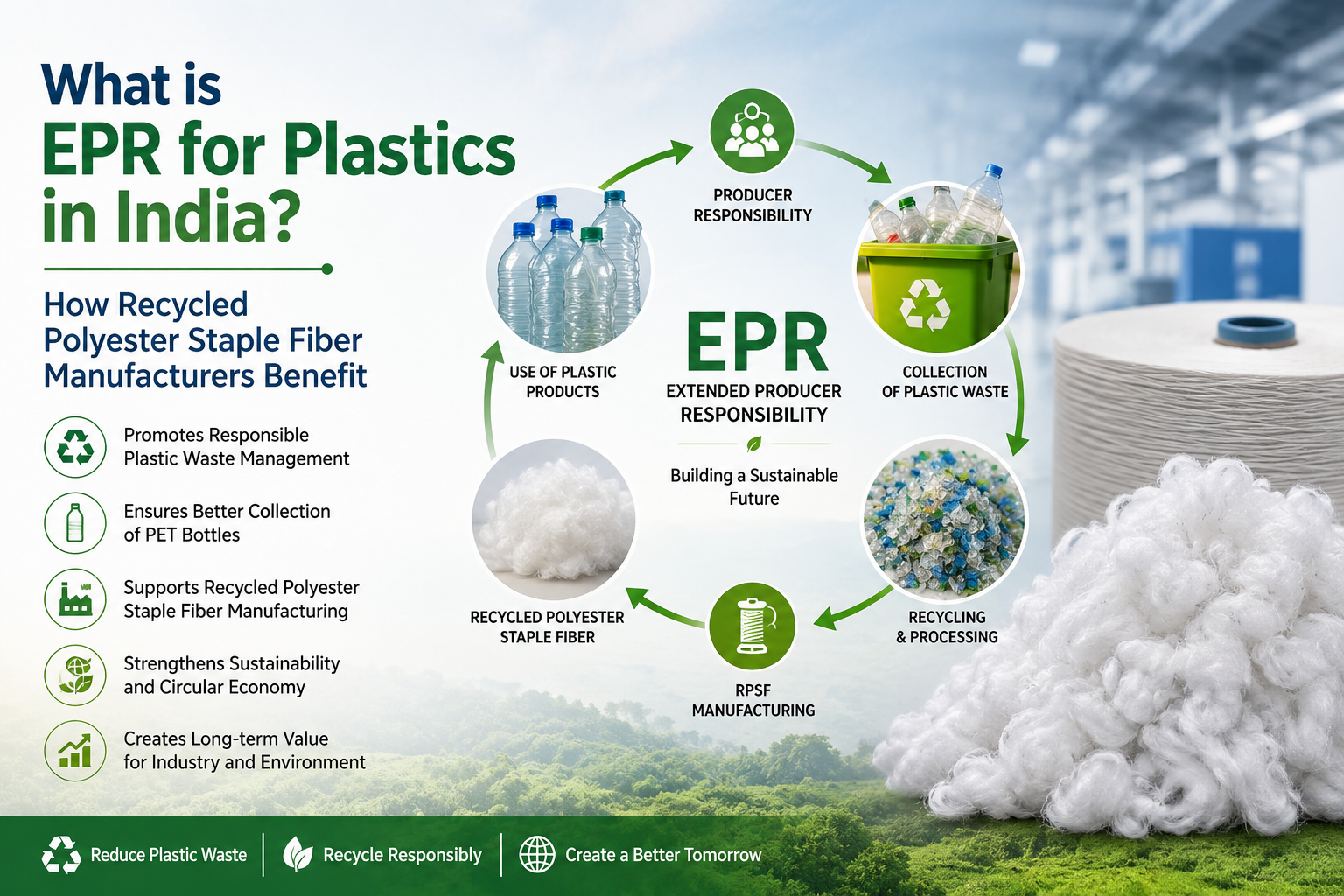
    What is EPR for Plastics in India? How Recycled Polyester Staple Fiber Manufacturers Benefit

    India is taking multiple steps to curb plastic wastage by introducing stricter regulations and one of the most impactful steps is Extended Producer Responsibility (EPR). As plastic consumption continues to grow, EPR has become an important framework for encouraging responsible waste management and recycling. The policy has opened up new opportunities for the Recycled Polyester Staple Fiber (RPSF) industry, while promoting sustainable manufacturing operations.

    In this blog, we will discuss what EPR for plastics means in India and how RPSF manufacturers are benefiting from this changing regulatory scenario.

    EPR for Plastics: The Facts You Need to Know

    Extended Producer Responsibility (EPR) is a policy that makes producers, importers and brand owners responsible for managing the plastic waste created by the products they introduce into the market. EPR transfers the burden away from municipalities or consumers and places the onus on businesses to actively collect, recycle and dispose of plastic waste.

    The Central Pollution Control Board (CPCB) of India has issued guidelines on Extended Producer Responsibility (EPR) under the Plastic Waste Management Rules to promote effective plastic recycling and reduce environmental pollution.

    The primary objective of EPR is to increase recycling rates, decrease landfill waste, and promote the use of recycled materials in manufacturing.

    Turning Plastic Waste into a Valuable Resource

    EPR’s big benefit is that it transforms plastic waste into a valuable industrial raw material.

    PET bottles recovered through organized Waste Management systems are washed, segregated and converted into PET Flakes and finally into high quality Recycled Polyester Staple Fiber. This systematic recycling process forms a sustainable supply chain and reduces dependence on virgin polyester.

    With EPR compliance improving all over India, more and more recyclable PET bottles are becoming available, which directly benefits RPSF manufacturers.

    Reliable availability of raw materials

    The biggest challenge in recycled fiber manufacturing is a consistent supply of quality PET waste.

    EPR encourages organized collection systems, which provides manufacturers with a more stable and dependable stream of recyclable plastic bottles. This helps in better production planning, less shortage of raw materials and supports smooth manufacturing operations.

    With a steady supply chain, manufacturers can have consistent quality in their products all year round.

    Better fiber quality

    The quality of Recycled Polyester Staple Fiber (RPSF) largely depends on the quality of PET bottles collected for recycling.

    EPR driven collection systems tend to lead to better segregation, cleaner plastics waste and lower contamination. Using high quality PET flakes, stronger, cleaner and more consistent polyester fibers are produced for a variety of industrial applications.

    Better raw materials are used to produce better quality RPSF products conforming to domestic and international quality standards.

    Popularity of Eco-Friendly Products Growing

    Many industries are looking for eco-friendly raw materials to meet sustainability goals and customer expectations.

    Car makers, textile companies, producers of nonwovens, furniture makers and home furnishing brands are increasingly choosing recycled polyester fiber over virgin alternatives.

    With companies racing towards ESG commitments and circular economy goals, demand for certified recycled materials continues to increase, driving long-term growth opportunities for RPSF manufacturers.

    More export opportunities

    Now, global buyers are seeking suppliers that use recycled raw materials and responsible manufacturing practices.

    Manufacturers can improve their credibility in international markets through EPR supported recycling ecosystem in India. In many instances, following sustainability standards in Europe, North America, Australia and other environmentally-conscious markets results in increased business opportunity.

    This makes Indian RPSF makers a competitive supplier in the global recycled fibre industry.

    Supporting India’s Circular Economy

    EPR is key to building a circular economy where plastic waste is continuously collected, recycled and reused instead of being thrown away.

    Each recycled PET bottle converted into polyester staple fiber helps to keep waste out of landfills, save natural resources, reduce carbon emissions and reliance on petroleum-based virgin polyester.

    The RPSF industry has emerged as a major contributor to this circular manufacturing model by converting waste into valuable industrial products.

    The Future for EPR and the RPSF Industry

    As the recycling infrastructure in India is improving and the effectiveness of EPR implementation is increasing, the Recycled Polyester Staple Fiber industry is set for substantial growth.

    As advanced recycling technologies, improved collection systems and stronger regulation of the environment continue to improve, raw material availability and product quality will continue to improve. Manufacturers that invest in sustainable production processes today will be better positioned to meet future market demand.

    Read More: Choosing the right recycled polyester staple fiber for your industry

    Extended Producer Responsibility is not just a regulatory mandate but a catalyst for India’s pursuit of sustainable manufacturing. EPR promotes the improved collection and recycling of plastic waste, supporting the strengthening of the entire recycling ecosystem and creating new opportunities for Recycled Polyester Staple Fiber manufacturers.

    RPSF manufacturers are well-positioned to take a leading role in India’s circular economy and the future of environmentally sustainable industrial production, with improved availability of raw materials, better product quality, increasing global demand and enhanced sustainability credentials.

  • Choosing the Right Recycled Polyester Staple Fiber for Your Industry

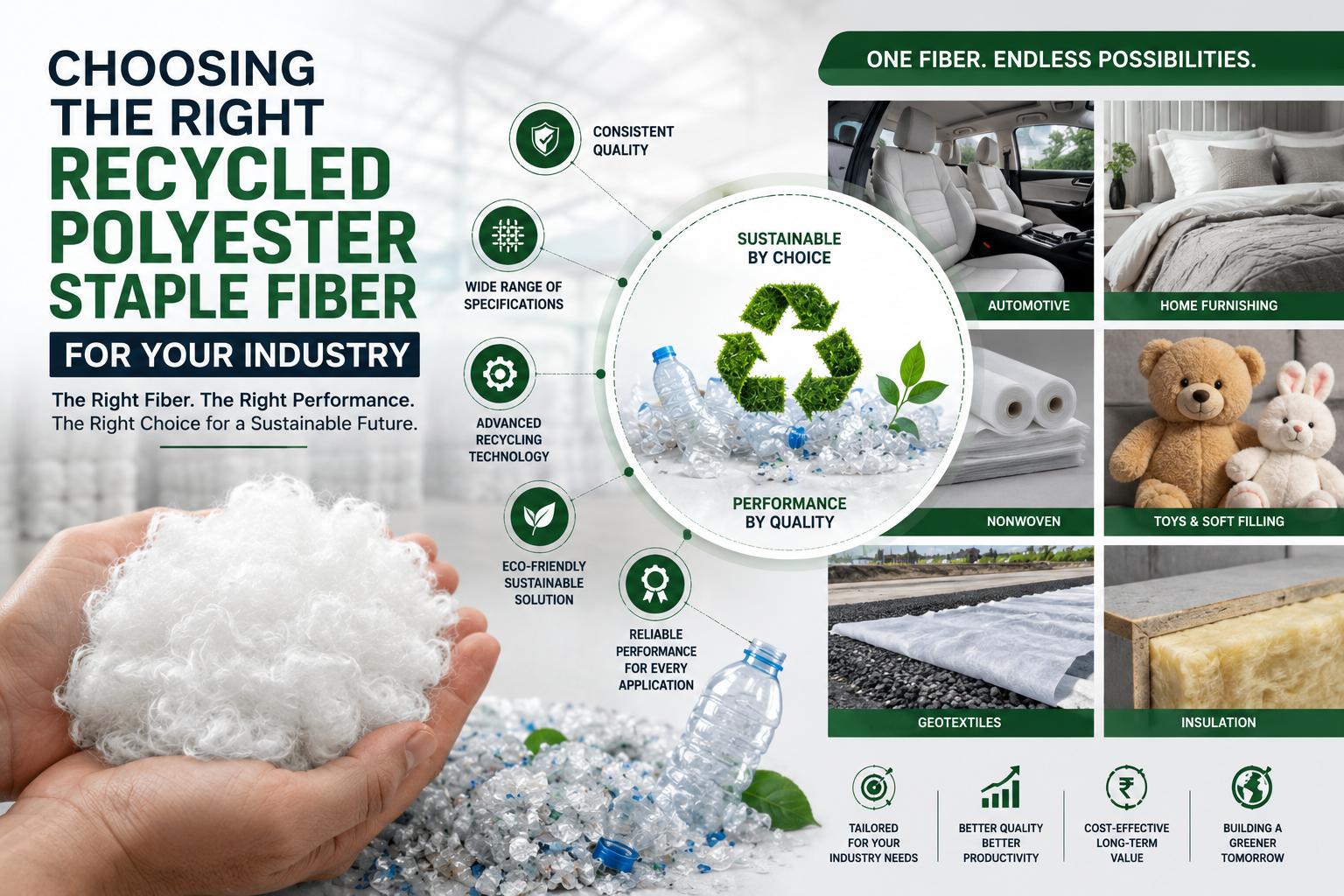
    Choosing the Right Recycled Polyester Staple Fiber for Your Industry

    Recycled Polyester Staple Fiber (RPSF) has become a preferred material for a wide range of applications as businesses across the globe move towards sustainable manufacturing. Made from recycled PET bottles, RPSF is an environmentally responsible alternative and a cost effective, versatile and highly durable choice for virgin polyester.

    But not all RPSF is created equal. Different industries have different fiber specs that are required to achieve the desired product performance. Choosing the right Recycled Polyester Staple Fiber can greatly improve product quality, production efficiency, and long-term value. Knowing the key factors will also help manufacturers make informed decisions that meet their production requirements.

    Understand Your Industry Needs

    Understand Your Industry’s Needs The first step to choosing the right RPSF is knowing the needs of your industry.

    For example, the automotive sector needs strong fibers with better resilience, whereas home furnishing manufacturers may prefer softness and loft. The producers of nonwoven fabrics generally look for a constant fiber length and processing efficiency.

    A clear definition of the end application helps you decide what fiber specifications are best suited to your production process.

    Consider the Fiber Denier

    Fiber denier is the thickness of an individual fiber and is an important factor in product performance.

    • Low denier fibers are soft, and are ideal for high quality textiles, apparel and fine nonwovens.
    • Medium denier fibers are used to fill cushions, pillows, quilts and furniture.
    • Higher denier fibers offer greater strength and durability in industrial applications such as geotextiles, automotive components and insulation products.

    The right denier selection ensures functional and quality expectations of the final product.

    Pick the Correct Fiber Length

    Processing efficiency and product performance are directly affected by fiber cut length.

    For spinning and textile applications, shorter fibers are generally preferred and longer fibers are generally used for filling materials, nonwoven manufacturing and industrial products.

    Choosing the right fiber length will enhance machine performance, minimize waste and enhance overall quality of finished products.

    Assess Fiber Quality

    High quality RPSF gives consistency in manufacturing performance.

    Considerations when choosing a supplier include:

    • Uniformity of fibers
    • Tensile strength
    • Crimp uniformity
    • Color Uniformity
    • moisture levels
    • Levels of contamination and cleanliness

    Quality control procedures are strict and reliable manufacturers work to industry standards in each production batch.

    Advanced Recycling: Virgin-Like Performance

    Modern recycling technologies have achieved great progress in improving the quality of recycled polyester staple fiber.

    Today sophisticated sorting, washing, extrusion and quality inspection systems produce RPSF that can perform as well as virgin polyester in many applications.

    It means manufacturers can meet sustainability targets without compromising on product durability, resilience or appearance.

    Environmental Benefits & Sustainability

    One of the biggest advantages of RPSF is its positive effect on the environment.

    Manufacturers help by converting discarded PET bottles into valuable industrial fibers:

    • Cut down on plastic waste
    • Minimize landfill contamination
    • Less carbon emissions
    • Preserve natural resources
    • Support circular production

    Using high quality recycled fiber is one indicator of a company’s commitment to responsible and sustainable manufacturing.

    Work with an Established Manufacturer

    The quality of the fiber is no better than the quality of your supplier.

    RPSF experienced manufacturer provides:

    • Reliable product quality
    • Reliable production capability
    • Technical know-how
    • Custom fiber specs.
    • Timely delivery
    • International Quality Standards Adherence

    A trusted supplier is a long-term manufacturing partner, not just a material provider.

    Applications in Different Industries

    Today RPSF serves a wide variety of industries including:

    • Home furnishings
    • Interior automotive
    • Nonwoven fabrics.
    • Geotextiles .
    • Products for bedding
    • Soft filling and toys
    • Filtration media
    • Insulating products
    • Manufacture of textiles

    Flexibility enables manufacturers to create sustainable products without compromising on performance or reliability.

    Think Outside Cost

    Price is an important consideration but do not select RPSF on price alone. This can lead to inconsistency in product quality and increased production losses.

    Rather than just looking for the lowest price, businesses should consider the total value that a supplier brings to the table. Things like consistent quality, reliability, technical support, and how the product or service performs over time.

    By using high-quality recycled polyester staple fiber, you can increase your production efficiency and customer satisfaction.

    Also Read: How advanced recycling technology is improving RPSF quality

    Quality, sustainable manufactured products are dependent on the right Recycled Polyester Staple Fiber. Factors such as fiber denier, cut length, quality consistency, supplier experience, and application needs all play a role in determining the best material to use.

    As industries continue to emphasize environmental responsibility, high quality RPSF offers an effective solution that marries sustainability with superior performance. By collaborating with a trusted manufacturer and selecting the right fiber specifications, companies can enhance product quality, increase operational efficiency, and help create a greener future.

  • How Advanced Recycling Technology Is Improving RPSF Quality

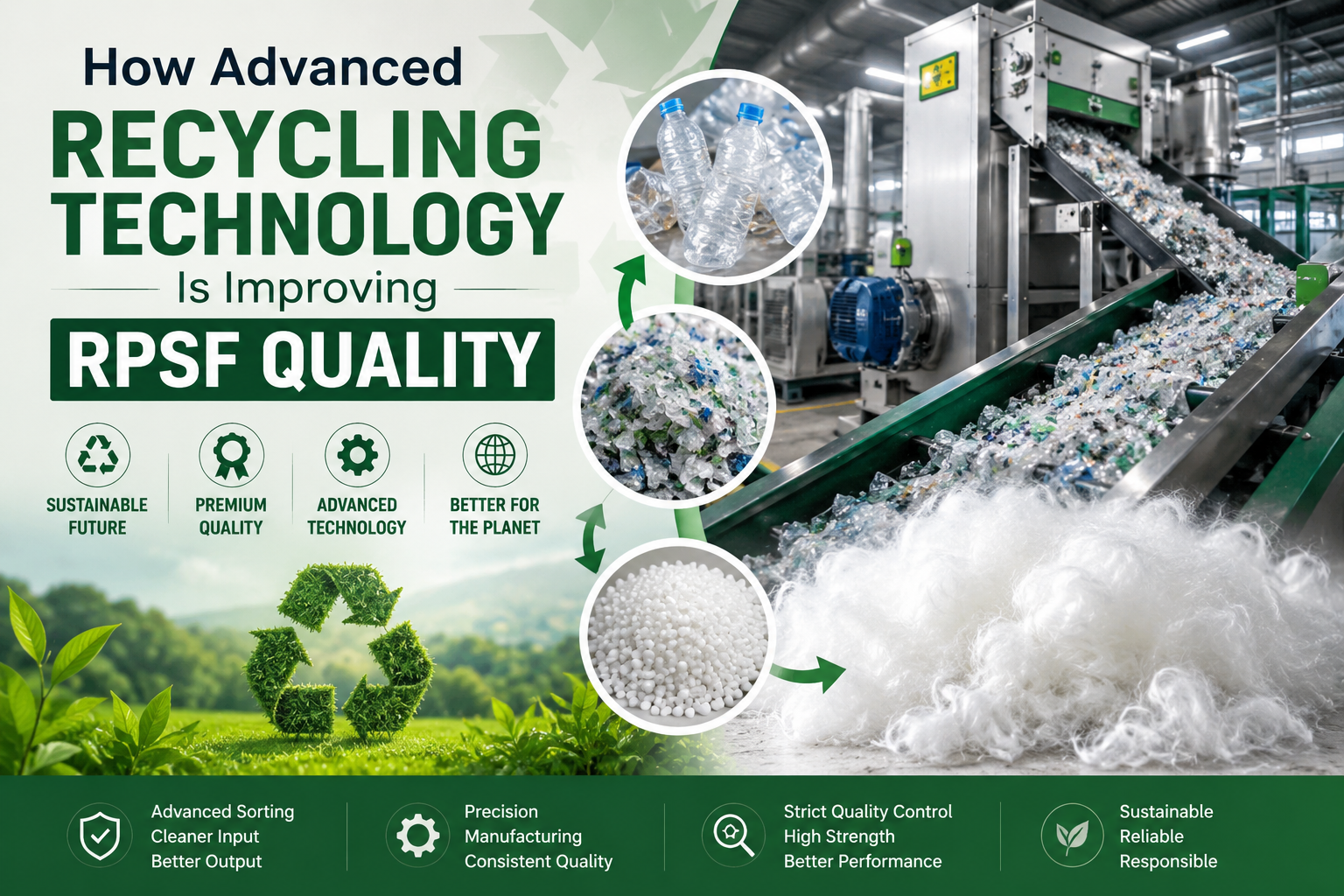
    How Advanced Recycling Technology Is Improving RPSF Quality

    As industries around the world are moving towards sustainable manufacturing, Recycled Polyester Staple Fiber (RPSF) has emerged as a preferred alternative to virgin polyester fiber. RPSF is made from plastic waste and recycled PET bottles, which helps reduce landfill waste and conserve natural resources. However, the rising acceptance of RPSF is not only due to its environmental benefits, but also due to its dramatic improvement in quality.

    Modern RPSF produced from advanced recycling technology provides superior strength, consistency and performance, making it suitable for a wide range of industrial and textile applications. High-quality RPSF is being experienced like never before by global manufacturers from automotive interiors to home furnishings and nonwoven fabrics.

    The Evolution of RPSF Manufacturing

    The recycling industry has changed a lot in the past 10 years. Initial recycling techniques frequently produced variable fiber quality because of contamination and restricted processing capacity. Today, manufacturers have highly automated production lines and precision equipment that guarantee better control at all stages of the manufacturing process.

    Today’s recycling plants work hard to keep quality control tight and material recovery high, so recycled fibers can be as good as virgin polyester in appearance and performance.

    Improved sorting and cleaning of PET bottles

    The quality of RPSF starts with the quality of recycled PET bottles.

    Modern recycling plants are equipped with automated sorting systems that use optical sensors and artificial intelligence to sort bottles by color, polymer type and contamination. This helps to reduce impurities before processing even starts.

    Different washing steps (hot wash, friction wash, chemical wash) are used for the removal of labels, glues, dirt and other impurities. Cleaner PET flakes lead to cleaner, stronger and more durable polyester fibers.

    Production for Uniform Fiber Quality

    One of the biggest gains in modern RPSF production has been the development of precision manufacturing.

    In modern extrusion systems temperature, pressure and melt flow are precisely controlled during the production of fibres. This guarantees uniform fiber diameter, higher tensile strength and consistent product quality for each production batch.

    Manufacturers can also make fibers in different deniers, cut lengths and specifications to suit various industries.

    Improved Quality Control Systems

    Quality control has become a part of advanced recycling technology.

    Modern RPSF manufacturers perform continuous testing during production including:

    • Test of fiber strength
    • Moisure Content Test
    • Color Consistency Check
    • Inspection of crimp uniformity
    • Detection of Contaminations
    • Checking dimensional accuracy

    We have rigorous quality checks in place to ensure that every batch meets our customer expectations and international quality standards.

    Improved sustainability without sacrificing performance

    Many companies used to think recycled fibers couldn’t be up to the same standard as virgin polyester. Today’s technology has changed that perception.

    Advanced recycling processes now produce RPSF which offers:

    • Great durability
    • High resilience
    • Uniform texture
    • Improved heat insulation
    • Excellent filling ability
    • Dependable processing capabilities

    This means manufacturers no longer need to trade off sustainability and product performance.

    Supporting Industrial High Performance Applications

    The better quality of RPSF leads to its wider application in many industries.

    High quality recycled polyester staple fiber is used widely today in:

    • Automotive Interior
    • Furniture padding
    • Pillows & Coverlets
    • Geotextiles
    • Nonwoven textiles.
    • Home and furnishings
    • Filtration products
    • Insulation materials

    It’s versatile, making it the ideal solution for manufacturers wanting to reduce their environmental footprint without compromising product quality.

    Innovation & the Circular Economy

    Advanced recycling technologies are key enablers of the circular economy.

    Today , recycling systems turn discarded PET into valuable raw materials for industrial use , instead of millions of plastic bottles being dumped into landfills or the ocean . This cuts plastic pollution and dependence on virgin petroleum-based resources.

    The result is a manufacturing model that is good for business, good for consumers and good for the environment.

    The Future of RPSF Production

    As technology continues to evolve, the future of RPSF looks even brighter.

    Innovations such as AI-powered quality inspection, smart automation, energy-efficient recycling systems and improved material traceability are allowing manufacturers to produce even higher quality recycled fibres with a lower environmental impact.

    These improvements will enhance RPSF’s position as one of the most sustainable and reliable materials in the global textile and manufacturing industries.

    Also Read: The journey of a PET Bottle before it becomes RPSF

    Advanced recycling technology has improved the quality and reliability of Recycled Polyester Staple Fiber. Today RPSF has automated sorting, accurate manufacturing, quality control and continuous improvement resulting in superior performance and sustainable manufacturing.

    As sustainability gains momentum, industries are turning to high-quality RPSF as the optimum choice for those requiring long-lasting, environmentally friendly and economical fiber options. As technology continues to evolve, the future of recycled polyester staple fiber looks brighter than ever, proving that innovation and sustainability can go hand in hand.

  • The Journey of a PET Bottle Before It Becomes RPSF

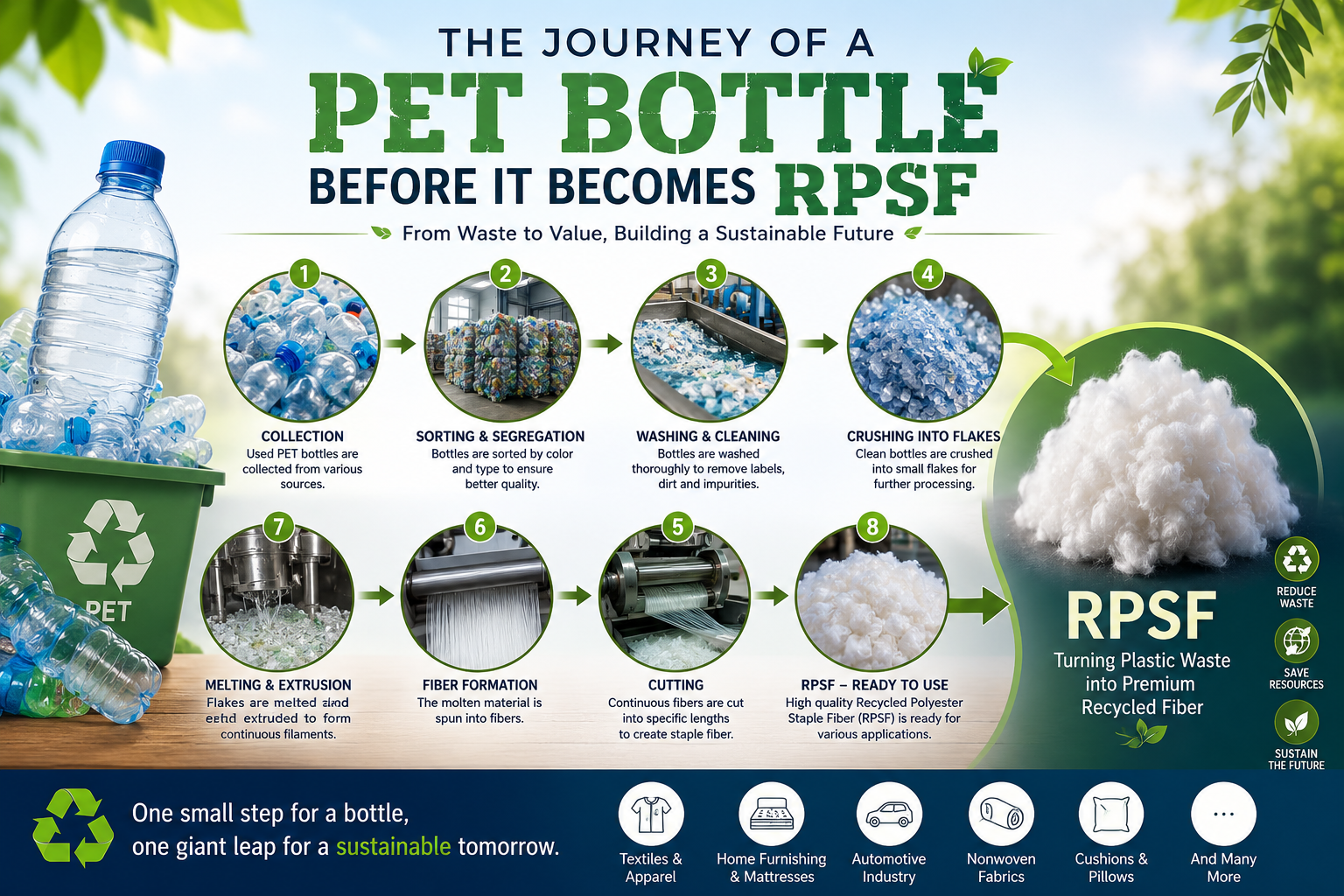
    The Journey of a PET Bottle Before It Becomes RPSF

    Every day, millions of plastic bottles are used and thrown away around the world. These bottles are waste for many people, but modern recycling processes can turn them into valuable raw materials. One of the most exciting examples of sustainable recycling is the conversion of PET bottles into Recycled Polyester Staple Fibre (RPSF).

    RPSF is commonly found in such industries as textiles, home furnishings, automotive manufacturing, mattresses, nonwoven fabrics and filling materials. But before a PET bottle can be turned into a high-quality fibre, it has an interesting journey of recycling and processing.

    What is PET Bottle?

    PET or Polyethylene Terephthalate is one of the most used plastics for beverage and water bottles. It is light weight, durable and highly recyclable which makes it an ideal material for sustainable recycling initiatives.

    Recycling facilities collect used bottles and turn them into reusable materials, such as RPSF, rather than letting them end up in landfills or oceans.

    Step 1: Collection of PET Bottles

    The process begins with the collection of post-consumer PET bottles.

    The bottles are collected from:

    • Recycling centres
    • The systems for collecting waste
    • Local recycling programs
    • Scrap dealers;
    • Waste streams from industry

    Efficient collection systems are essential to maintaining a steady stream of recyclable plastic into RPSF production.

    Step 2: Sort and divide

    The bottles are then sent to recycling facilities where they are carefully sorted.

    The sorting separates

    • Other plastics PET bottles
    • From clear bottles to coloured bottles
    • Clean bottles from bottles infected

    Advanced sorting technologies and manual inspection help ensure that only appropriate PET materials are forwarded to the next phase of processing.

    Step 3: Wash and Clean

    Cleanliness is required for the production of high quality recycled fibre.

    Bottles are cleaned in several stages to remove:

    • Tags
    • Lids Sealants
    • Dust and dirt
    • Remaining Liquids
    • Other Pollutants

    Today recycling plants use advanced washing systems to get the highest possible purity before further processing.

    Step 4: Crushing of PET Flakes

    After being washed and cleaned the bottles are crushed into small pieces called PET flakes.

    These flakes are the main raw material used in fibre manufacturing. Additional quality controls are carried out to ensure uniformity in size and cleanliness during this phase.

    The quality of the PET flakes has a direct impact on the performance and durability of the final RPSF product.

    Step 5: Melting and Extrusion

    These PET flakes are then fed into special machinery which melts the flakes at controlled temperatures.

    The molten material is passed through fine spinnerets to make continuous polyester filaments. This process is called extrusion.

    Advanced manufacturing technologies ensure consistent fibre formation and high quality production standards.

    Step 6: Fibre making and cutting

    After formation of the filaments, they are cooled, drawn and otherwise processed to impart desired strength and characteristics.

    The continuous filaments are then cut to a specific length to produce Recycled Polyester Staple Fibre.

    Depending on the industrial needs different types of fibres can be manufactured including:

    • Fibres (solid)
    • Hollow fibers
    • Siliconised fibers
    • Conjugate fibres

    Each type has its own applications in different industries.

    Step 7: Quality Check and Packing

    RPSF is subjected to stringent quality control procedures before it reaches the customers.

    Manufacturers test for:

    • Strength of fibre
    • Consistently long
    • Cleanliness.
    • Moisture content
    • Colour quality
    • Performance Parameters

    Once approved, the fibres are baled and then sent to textile mills, mattress makers, nonwoven fabric manufacturers and other industrial users.

    Environmental Advantages of the Process

    The bottle-to-fibre recycling process has considerable environmental benefits

    The following are:

    • Less plastic waste in the landfill
    • Reducing levels of pollution
    • Saving natural resources
    • Less reliance on virgin polyester
    • Promoting sustainable manufacturing practices
    • Enabling a circular economy

    Every recycled PET bottle is another step towards a cleaner, more sustainable future.

    Also Read: How bottle to fiber technology is revolutionizing the RPSF industry

    Conclusion:

    The journey of a PET bottle before it becomes RPSF is an amazing example of how innovation and sustainability can go hand in hand. A discarded plastic bottle can start out as a valuable industrial material that is used in countless products around the world.

    In Conclusion The transformation of PET bottles into Recycled Polyester Staple Fibre will continue to be a crucial approach to reducing plastic waste and promoting sustainable industrial development, with ongoing advancements in recycling technology and increasing awareness of environmental concerns. “This shift shows that waste is not just to be thrown away, but can be an important resource for the future.”

  • How Bottle-to-Fiber Technology Is Revolutionizing the RPSF Industry

    How Bottle-to-Fiber Technology Is Revolutionizing the RPSF Industry

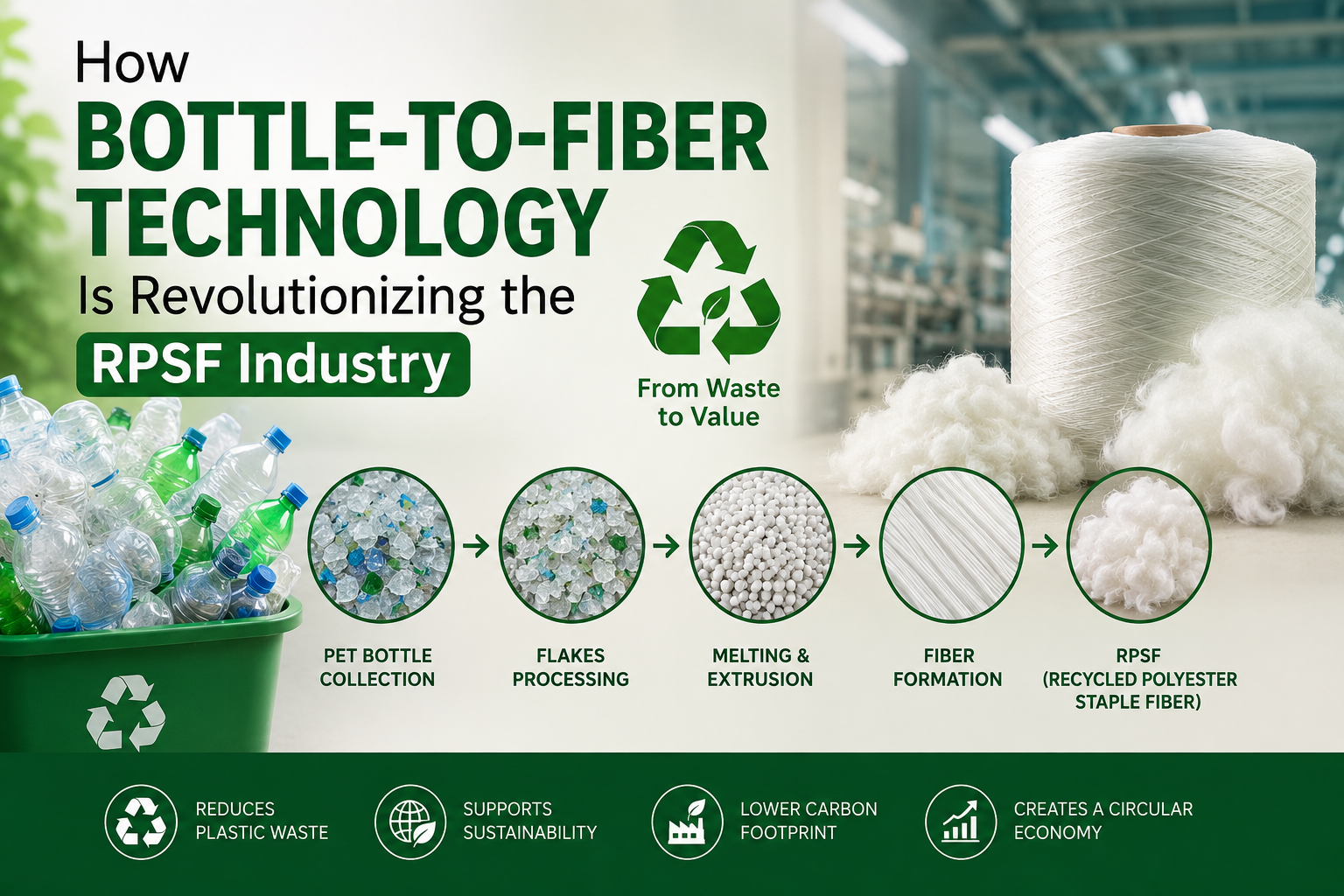
    As industries worldwide shift to sustainable manufacturing, the need for environmentally responsible raw materials continues to increase. Bottle-to-fiber technology has revolutionised recycling. The sophisticated process converts waste PET plastic bottles into premium Recycled Polyester Staple Fibre (RPSF) to add value to waste and lessen environmental impact.

    Bottle-to-fiber technology is today not only helping to solve the global plastic waste problem, but also revolutionising the RPSF industry by improving efficiency, quality and sustainability.

    Bottle-to-Fiber Technology Explained

    Bottle-to-fiber technology is a recycling process that turns used PET (Polyethylene Terephthalate) bottles into polyester staple fibres. Plastic bottles are collected and processed into valuable industrial materials, instead of being dumped into landfills or the oceans.

    This process typically includes:

    • Post-consumer PET bottle collection
    • Sorting and separating by colour and quality
    • Cleaning and Contaminant Removal
    • Crushing Bottles to PET flakes
    • Melt and extrude
    • Cutting and Fibre Forming

    The end product is recycled polyester staple fibre which can be used in various industries like textiles, automotive, home furnishings and nonwoven applications.

    Solving the Problem of Global Plastic Waste

    One of the biggest advantages of bottle-to-fibre technology is its ability to cut down on plastic waste.

    Every year billions of plastic bottles are discarded around the world. Overflowing landfills and pollution of the environment result from conventional waste disposal methods. These PET bottles are then turned into RPSF, which diverts huge amounts of waste from the environment.

    Such recycling approach supports global sustainability goals and promotes the responsible use of resources.

    Development of a circular economy

    Bottle-to-fiber technology is essential to creating a circular economy.

    Instead of the traditional model of “produce, use and dispose,” recycled PET bottles are fed back into the production cycle as valuable raw materials. This increases the life of plastic products and cuts down on the need for virgin resources.

    This circular economy approach helps industries to reduce waste and make the best use of their materials, leading to more sustainable and environmentally friendly manufacturing.

    Making Manufacturing More Sustainable

    With the increased pressure on businesses to reduce their environmental footprint, RPSF produced using bottle-to-fiber technology is a very attractive alternative to virgin polyester.

    DIVERSION AND SUSTAINABILITY BENEFITS OF RECYCLED PET BOTTLES:

    • Less waste to landfill
    • Less dependency on petroleum resources
    • Reducing carbon emissions
    • More efficient use of resources
    • Backings for corporate sustainability initiatives

    This, in turn, drives up the demand for RPSF, as many global brands are now prioritising recycled materials in their supply chains.

    Improvements in Fibre Quality

    When recycling technology was in its infancy, questions about the quality of recycled fibres were frequent. Modern bottle-to-fibre systems, however, have considerably improved the standards of production.

    Today’s advanced recycling facilities utilise sophisticated sorting, washing and processing technologies to ensure production of quality fibre. Thus, recycled polyester staple fibre now provides excellent performance, durability and consistency suitable for demanding industrial applications.

    This quality improvement has resulted in acceptance of RPSF in many sectors.

    Growing Industrial Applications

    RPSF’s versatility continues to fuel its adoption across a wide variety of industries.

    Common applications are:

    • Mattresses & Bedding Products
    • Cushion and stools
    • Car interiors and
    • Nonwoven material.
    • Upholstery fabrics
    • Textile goods
    • Insulation products filling soft toys

    As bottle-to-fiber technology advances, manufacturers are finding new ways to include recycled fibres into products without compromising quality or performance.

    Supporting Global Goals for Sustainability

    More governments, businesses and environmental groups are supporting recycling programs that cut waste and save resources.

    These goals are well served by bottle-to-fiber technology by:

    • Developing Recycling Infrastructure
    • Optimise waste collection systems
    • Supporting green production
    • Minimising environmental pollution
    • Building sustainable supply chains

    The benefits make the RPSF industry a major contributor to the world’s sustainability efforts.

    Also Read: Why is demand for RPSF growing at 7.7 CAGR globally key drivers explained

    Conclusion

    Bottle to fibre technology is a breakthrough innovation in the recycled polyester staple fibre industry. This technology transforms discarded PET bottles into valuable industrial materials, and helps to tackle plastic waste challenges, while promoting sustainable manufacturing practices.

    With increasing awareness of the issues surrounding the environment and as industries seek greener alternatives, bottle-to-fiber technology will play an increasingly important role in shaping the future of the RPSF industry. “With innovation, resource efficiency and responsible recycling, the industry is proving that waste can be a valuable resource for a more sustainable world.”

  • Why is Demand for RPSF Growing at 7.7% CAGR Globally? Key Drivers Explained

    Why is Demand for RPSF Growing at 7.7% CAGR Globally? Key Drivers Explained

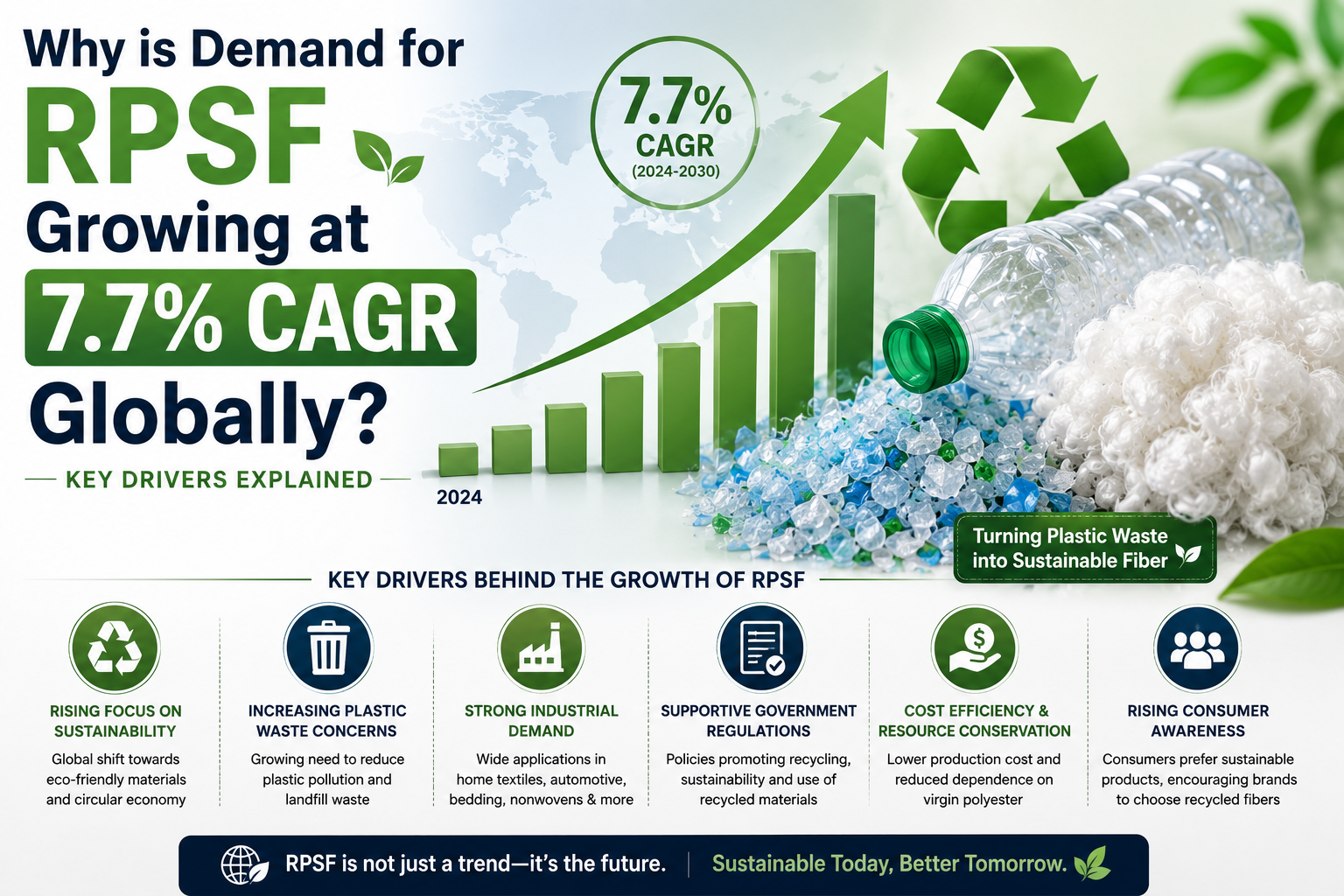
    The global market for Recycled Polyester Staple Fiber (RPSF) is growing at an impressive pace with market reports projecting a Compound Annual Growth Rate (CAGR) of approximately 7.7% in the foreseeable future. With the world’s industries becoming ever more concerned with sustainability, resource efficiency and environmental responsibility, RPSF has become a material of choice for a number of sectors.

    RPSF, made from recycled PET bottles, provides a practical solution to reducing plastic waste, while still meeting the performance demands of today’s industries. But what is causing this rapid growth? Let’s take a look at the key drivers for the increasing global demand for recycled polyester staple fiber.

    The growing focus on sustainability

    One of the biggest drivers of RPSF demand is the global move towards sustainable manufacturing and consumption practices.

    Among governments, businesses and consumers there is more awareness emerging about the environmental consequences of plastic waste and over consumption of resources. Therefore, industries are looking for materials that align with their sustainability goals.

    RPSF helps producers to reduce their reliance on virgin polyester and gives a second life to discarded plastic bottles. This fits in well with global environmental initiatives and corporate sustainability commitments.

    Fears over Growing Plastic Waste

    Plastic pollution is a worldwide problem. Every day millions of PET bottles are thrown away, creating a huge burden on waste management systems and natural ecosystems.

    This waste is converted to industrial value in the form of recycled polyester staple fiber. Manufacturers convert used PET bottles into high-quality fibers, helping reduce landfill waste and support recycling efforts.

    As efforts to tackle plastic pollution intensify from governments and organisations, demand for recycled materials like RPSF is also on the rise.

    Strong Demand from Different Industries

    Another important reason for the growth of RPSF is its versatility.

    Currently, recycled polyester staple fiber is widely used in:

    • Home furniture
    • Bedding and mattresses.
    • Cushions and cushions
    • Car interiors
    • Non woven fabrics
    • Production of textiles
    • Upholstery articles
    • Stuffed toys and filling materials

    Due to its durability, flexibility, and cost-effectiveness, RPSF is constantly expanding its use among various industries and applications.

    Corporate Sustainability Programs

    Many global brands have set ambitious Environmental, Social and Governance (ESG) goals. These initiatives often include commitments to reduce carbon emissions, cut waste and increase the use of recycled materials.

    To reach these goals, manufacturers are adding more and more RPSF into their production processes. Recycled fibers allow companies to show their dedication to the environment and meet consumers’ demand for sustainable products.

    As sustainability becomes a competitive advantage, demand for recycled polyester staple fiber is likely to grow that much more.

    Government Regulations to Support Recycling

    Governments across the world are implementing stricter regulations on waste management, recycling and environmental protection.

    Many countries today provide incentives, recycling requirements and sustainability policies to encourage the use of recycled materials. These regulations are leading companies to use green raw materials and cut their reliance on virgin resources.

    As regulatory frameworks continue to evolve, RPSF manufacturers are well placed to capitalize on the growing demand for sustainable alternatives.

    Cost savings and efficiency of resource utilization

    Economically, RPSF is benefiting from its growth but sustainability continues to be a key driver.

    Recycled polyester staple fiber is often a cheaper alternative to virgin polyester. Manufacturers can achieve reliable performance with less reliance on raw material and better resource utilization.

    Furthermore, recycling of PET waste preserves the petroleum-based resources used in traditional polyester manufacturing, and therefore RPSF is promising from both environmental and economic aspects.

    Consumer Awareness is Growing

    Today’s consumers are more aware of how the products they purchase affect the environment. Today many consumers look for brands that are sustainable whether they are buying clothes, furniture, bedding or automotive products.

    The change in consumer behavior is pushing manufacturers to incorporate recycled materials into their supply chains. With the increasing demand of eco-friendly products, the demand for reliable and quality recycled polyester staple fiber is also increasing.

    The Future of RPSF Industry

    The future of the recycled polyester staple fiber industry is very bright. The growth of the market is expected to be further accelerated by advancements in recycling technology, expanding collection networks and growing investment in sustainable manufacturing.

    With increasing support from governments, businesses and consumers, RPSF is becoming a key part of the global circular economy. It is a material that is increasingly vital for the future, because it helps to reduce waste, conserve resources, and provide consistent performance.

    Also Read: How Recycled Polyester Staple Fiber helps reduce plastic waste

    Conclusion:

    The rising demand for RPSF, at a CAGR of 7.7%, is more than just market growth. It signifies a global shift towards sustainability and responsible resource management.

    The factors driving the growth of the recycled polyester staple fiber market include increasing environmental awareness, increasing plastic waste problems, government regulations, corporate sustainability objectives, and increasing industrial applications.

    With the growing emphasis on sustainable materials across industries, RPSF will remain at the forefront of environmentally responsible manufacturing, paving the way for a cleaner and more resource-efficient future for generations to come.

  • How Recycled Polyester Staple Fiber Helps Reduce Plastic Waste

    How Recycled Polyester Staple Fiber Helps Reduce Plastic Waste

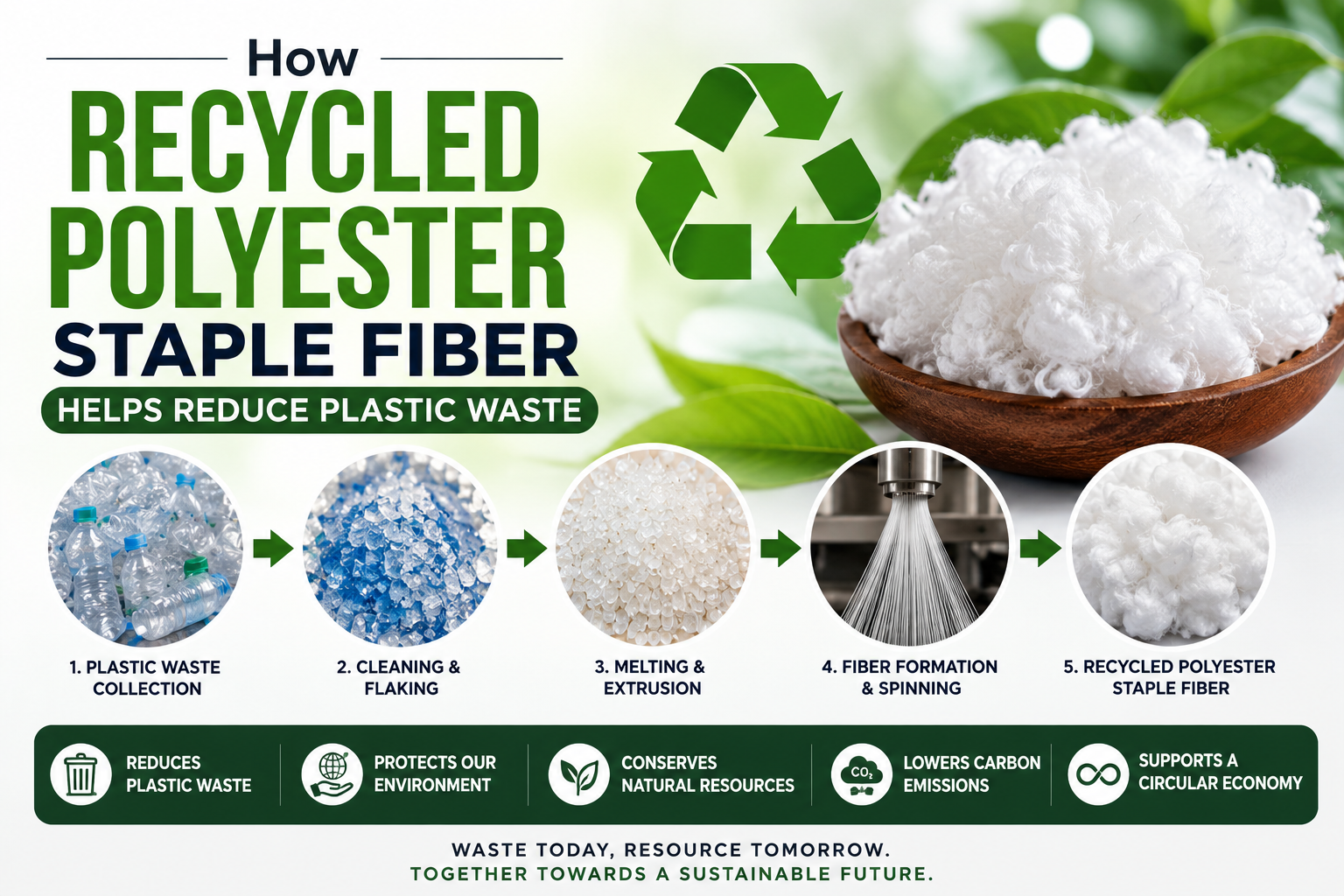
    Plastic waste is among the most pressing environmental challenges facing the world today. Every day millions of plastic bottles are thrown away and a huge amount ends up in landfills, rivers and oceans. With more and more industries and consumers seeking sustainable options, recycled polyester staple fibre (RPSF) has emerged as a viable option to convert plastic waste into value-added products.

    By using recycled polyester staple fibre made from discarded PET bottles, we can not only help manufacturing industries but also reduce environmental pollution and promote a circular economy.

    What is Recycled Polyester Staple Fibre

    Recycled polyester staple fibre is a synthetic fibre made from recycled PET (Polyethylene Terephthalate) plastic materials, the main source of which are beverage bottles. Instead of ending up as waste, they are collected, processed and transformed into long-lasting polyester fibres that can be used in a wide range of industrial and consumer applications.”

    The fibre produced has many of the same performance characteristics as conventional polyester, but virgin polyester production has a greatly reduced environmental impact.

    Turning Plastic Waste into Valuable Fibre

    The production process of recycled polyester staple fibre starts from the collection of post-consumer PET bottles. These bottles go through a series of processing steps for quality and cleanliness.

    A typical process is as follows:

    • Used PET bottles collection
    • Sorting and separation
    • Removing labels and caps
    • Cleaning and Washing
    • Crushing to PET flakes
    • Melting and extrusion
    • Fibre fabrication and cutting

    The recycled fibres after processing can be used in many industries, giving a second life to plastic waste and not polluting the environment.

    Recycling for Plastic Waste Reduction

    One of the biggest benefits of recycled polyester staple fibre is the direct contribution to reducing plastic waste.

    Taking waste out of landfills

    Plastic bottles take hundreds of years to break down. Recycling PET waste into polyester staple fibre helps divert large quantities of plastic from landfill and reduce the burden on waste management systems.

    Pollution Prevention – Ocean

    Improper disposal of plastic frequently causes it to enter rivers and oceans, endangering marine ecosystems. We can cut down on the amount of plastic that ends up in our natural environments and help keep our waterways clean by recycling PET bottles.

    Advocating Responsible Waste Collection

    The increasing demand for recycled materials means business for waste collection and recycling networks. This encourages improved waste disposal methods and increases recycling rates in communities.

    Advancing Sustainable Production

    An important element of sustainable manufacturing is recycled polyester staple fibre, which reduces the need for virgin raw materials.

    Traditional polyester production is heavily reliant on petroleum-based resources. Recycled PET bottles help manufacturers save natural resources and reduce the environmental burden of extracting and processing new raw materials.

    A lot of industries are now opting for recycled polyester staple fibre because it fits with their sustainability goals and helps them meet the increasing demand from consumers for more environmentally responsible products.

    Uses of Recycled Polyester Staple Fibre

    Recycled polyester staple fibre is very versatile and can be used in a variety of applications including:

    • Mattresses & Bedding Items
    • Pillows and cushions
    • Automotive interiors
    • Nonwoven fabrics
    • Upholstery goods
    • Textile production
    • Soft toys and filling material

    The need for sustainability is increasing and more and more industries are incorporating recycled fibres into their production processes.

    Beyond Waste Reduction: Environmental Benefits

    Recycled polyester staple fibre has many benefits beyond the reduction of plastic waste.

    Reduced Carbon Emissions

    Recycled polyester usually requires less energy to produce than virgin polyester, which helps to lower greenhouse gas emissions.

    Conservation of Resources

    Recycling of existing plastic material reduces the need for new petroleum based raw materials and helps to promote efficient resource use .

    Support for a circular economy

    One practical example of the circular economy is recycled polyester staple fibre. Waste is turned into value as materials that would normally be thrown away are converted into useful products.

    Also Read: Sustainable Manufacturing inside indias Recycled Polyester Staple Fiber industry

    Conclusion

    Innovative manufacturing such as recycled polyester staple fibre is one example of how we can help solve the increasing problem of plastic waste. Manufacturers recycle PET bottles into useful industrial products that help save the environment and promote sustainable production.

    As businesses and consumers become more environmentally conscious, recycled polyester staple fibre will continue to be a key player in reducing plastic pollution, conserving resources and creating a more sustainable future. Plastic waste is not a burden on the environment but a valuable resource if responsibly recycled and used in advanced manufacturing processes.