Selecting the right RPSF grade is essential for achieving product quality, improving manufacturing efficiency, and controlling production costs. RPSF, or Recycled Polyester Staple Fibre, is widely used in industries such as textiles, nonwoven fabrics, automotive interiors, bedding, furniture, and industrial applications. However, different manufacturing processes require different fibre properties. Choosing the appropriate grade helps ensure consistent performance, reduced material waste, and better end-product quality.
In this blog, we will explore the key factors to consider when selecting the best RPSF grade for your manufacturing process.
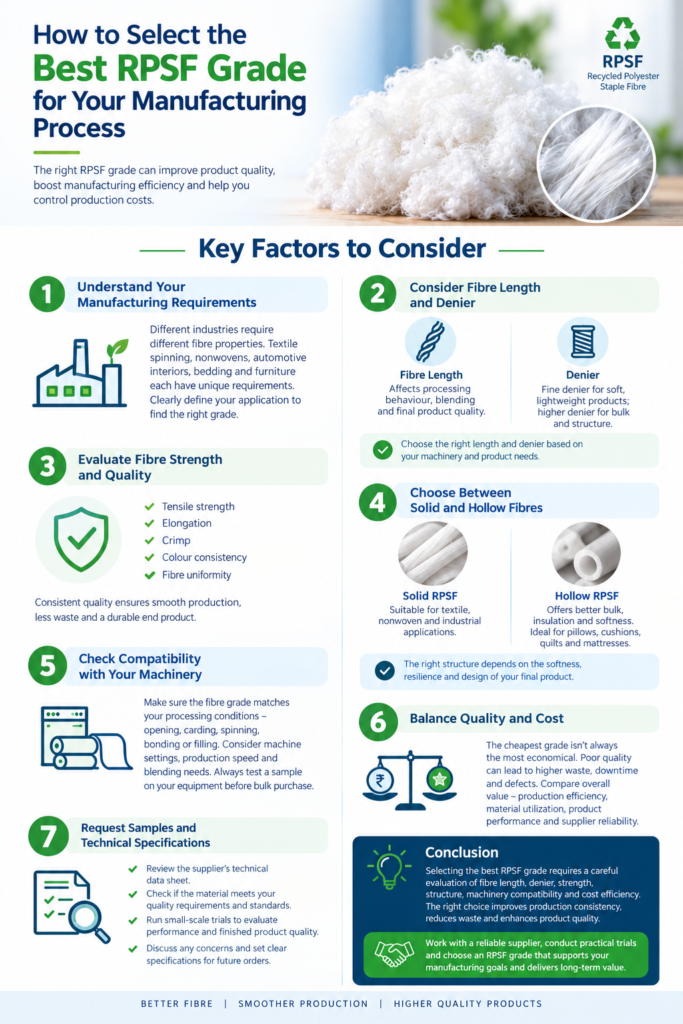
1. Understand Your Manufacturing Requirements
The first step in selecting an RPSF grade is to understand your specific application. Different industries require fibres with different physical and mechanical properties.
For example, textile spinning requires fibres with suitable fineness, length, and strength to produce quality yarn. Nonwoven manufacturing may require fibres that offer good bonding characteristics, uniformity, and resilience. Meanwhile, mattress and furniture manufacturers often prioritize bulkiness, softness, and recovery.
Clearly identifying your production requirements will help you narrow down the most suitable RPSF grades.
2. Consider Fibre Length and Denier
Fibre length and denier are two important parameters that directly influence manufacturing performance.
Fibre length: The length of the fibre affects its processing behaviour, blending ability, and final product quality. Longer fibres are generally suitable for applications requiring better fibre cohesion, while shorter fibres may be appropriate for certain nonwoven and filling applications.
Denier: Denier measures the weight of a fibre in relation to its length. Fine-denier fibres are often preferred for soft, lightweight products, whereas higher-denier fibres can provide greater bulk and structure in applications such as cushioning and padding.
Always select fibre length and denier according to your machinery, production method, and desired product characteristics.
3. Evaluate Fibre Strength and Quality
Consistent fibre strength is essential for maintaining smooth production and minimizing fibre breakage. Low-quality or inconsistent fibres can cause processing difficulties, increase waste, and affect the durability of the finished product.
Before choosing an RPSF grade, evaluate parameters such as tensile strength, elongation, crimp, colour consistency, and fibre uniformity. The importance of each parameter depends on the intended application.
Working with a reliable supplier that follows consistent quality-control procedures can help maintain stable production standards.
4. Choose Between Solid and Hollow Fibres
RPSF is available in different structures, including solid and hollow fibres. Each type serves specific manufacturing needs.
Solid RPSF: Solid fibres are suitable for various textile, nonwoven, and industrial applications where the required structure and performance can be achieved with a solid cross-section.
Hollow RPSF: Hollow fibres contain an internal cavity that can improve bulk, insulation, and lightweight performance. They are commonly used in pillows, cushions, quilts, mattresses, and other filling applications.
The choice between solid and hollow fibres should depend on the required softness, resilience, insulation, and overall product design.
5. Check the Compatibility with Your Machinery
Even a high-quality RPSF grade may not deliver the desired results if it is incompatible with your manufacturing equipment. Fibre specifications should match your processing conditions, including opening, carding, spinning, bonding, or filling operations.
Consider factors such as machine settings, production speed, fibre feeding behaviour, and blending requirements. Testing a sample on your existing machinery before making a bulk purchase can help identify potential issues and prevent unnecessary production losses.
6. Balance Quality and Cost
Price is an important consideration, but selecting the cheapest RPSF grade is not always the most economical decision. Poor fibre quality can lead to higher rejection rates, increased waste, equipment downtime, and inconsistent finished products.
Instead, compare grades based on overall production efficiency, material utilization, product performance, and supplier reliability. A slightly higher-priced grade may offer better long-term value if it improves productivity and reduces defects.
7. Request Samples and Technical Specifications
Before finalizing your purchase, request samples and review the supplier’s technical data sheet. Check whether the material meets your quality requirements and applicable industry standards.
Conduct small-scale production trials to assess processing performance and finished-product quality. Discuss any concerns with your supplier and establish clear specifications for future orders.
Conclusion
Selecting the best RPSF grade for your manufacturing process requires careful evaluation of fibre length, denier, strength, structure, machinery compatibility, and cost efficiency. The right choice can improve production consistency, reduce waste, and enhance the quality of your finished products.
Also Read: rpsfs contribution to european sustainability from recycled fiber to global trade
By understanding your application requirements, conducting practical trials, and partnering with a dependable supplier, you can identify an RPSF grade that supports your manufacturing goals while delivering long-term value and reliable performance.