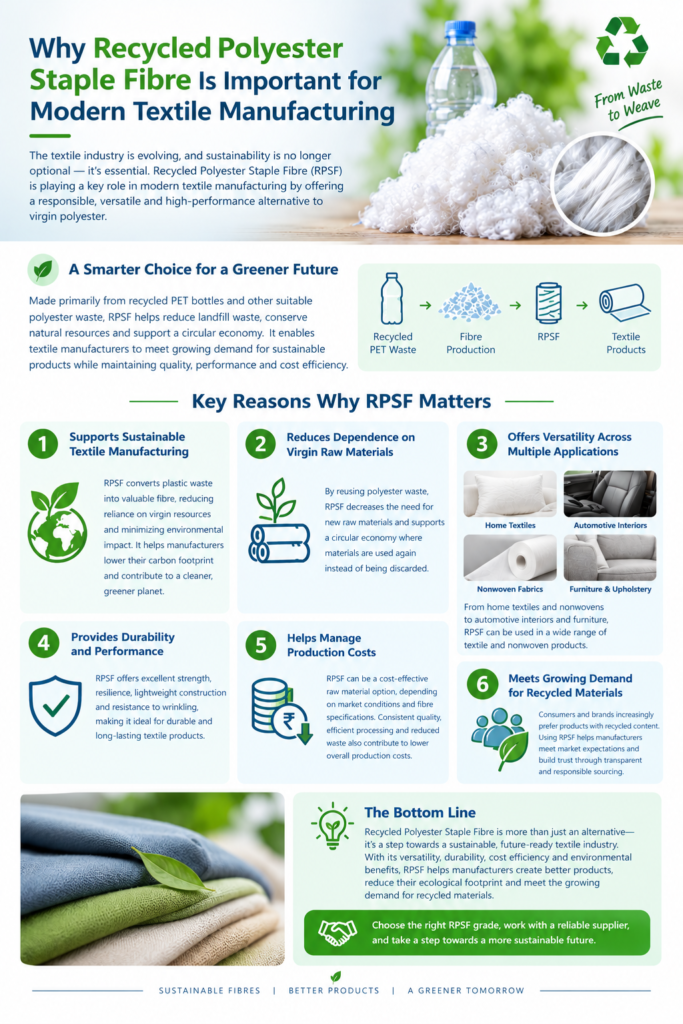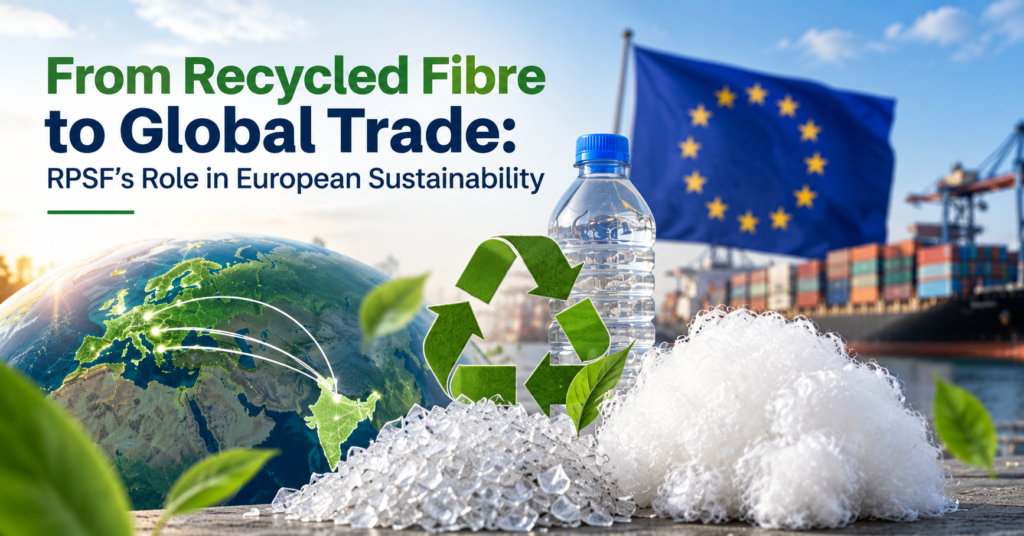
Recycled Polyester Staple Fibre (RPSF) is an important material for manufacturing and textile industries of India. RPSF is primarily made from recycled PET bottles and polyester waste, and provides manufacturers with a practical way to add recycled content to products while maintaining useful performance characteristics. But for what exactly is RPSF used and what industries rely on it?
Recycled polyester staple fibre is used in a wide range of industries, from home furnishings to automotive components. Here are the top 8 industries where RPSF is widely used in India.
1. Textile and Clothing Sector
The textile industry is one of the biggest users of recycled polyester staple fibre. RPSF can be blended with cotton, virgin polyester and other fibres to produce yarn and fabrics.
It is used in products such as clothing, uniforms, sportswear, jackets and workwear. Manufacturers can choose from various fibre lengths, deniers and colours depending on the requirements of the final product.
The use of recycled polyester also enables textile manufacturers to integrate recycled materials into their supply chains.
2. Home Furniture Industry
RPSF is popular in home furnishing products due to its durability and versatility. It is used in cushions, pillows, mattresses, blankets, quilts, upholstery and other household textile products.
Hollow conjugated polyester fibre is especially suited for applications requiring softness, resilience and good loft. Thus, recycled fibre can be effectively used as filling material for different products of home furnishing.
3. Automotive
Polyester fibres are employed in many interior and acoustic applications of the automotive industry. Nonwoven fabrics for seat components, carpets, trunk liners, door panels, insulation and other interior parts can be fabricated from RPSF.
Car makers and component suppliers are increasingly using recycled materials to help reduce the environmental impact of vehicle production.
4. Mattress and Bedding Industry
Polyester staple fibre is used by manufacturers of mattresses as a stuffing and cushioning material. RPSF can be used in layers of mattresses, pillows, comforters and other bedding products.
It is firm and form-holding, so it is suitable for products that require continuous support and rehabilitation.
5. Industry: Nonwovens
Another major area of application of RPSF is the nonwoven industry. Nonwoven sheets and materials can be produced from recycled polyester staple fibre by using needle punching and thermal bonding processes.
These materials find use in filtration products, protective materials, geotextiles, insulation, packaging and industrial uses.
6. Industry of Furniture and Upholstery
Furniture manufacturers use polyester staple fibre in sofas, chairs, cushions and upholstery products. RPSF provides the ability to add volume and cushioning and helps manufacturers to incorporate recycled content into furniture parts.
Depending on the end use requirements, different fibre specifications can be selected to offer softness, firmness, resilience or structural support.
7. Geotextile Industry and Construction Industry
RPSF is also emerging in applications in geotextiles and construction related products. Recycled polyester fibres are an alternative raw material for manufacturing nonwoven geotextile materials for separation, filtration, drainage and reinforcement applications.
This broadens the horizon of RPSF beyond the traditional textile manufacturing and demonstrates its versatility as an industrial raw material.
8. Industry of technical and industrial textiles
Technical textiles need materials with particular physical and performance characteristics. RPSF is found in products such as industrial felts, insulation materials, filtration media, protective fabrics, and other engineered textile applications.
The manufacturer can select fibre specifications based on required strength, thickness, density and processing method.
RPSF: What it is and why it is important for Indian Industries
Availability of PET waste, growing recycling infrastructure and demand for recycled materials are some of the factors supporting the increasing use of RPSF in India. The recycling of post-consumer PET bottles and polyester waste into staple fibre provides manufacturers with an alternative raw material source.
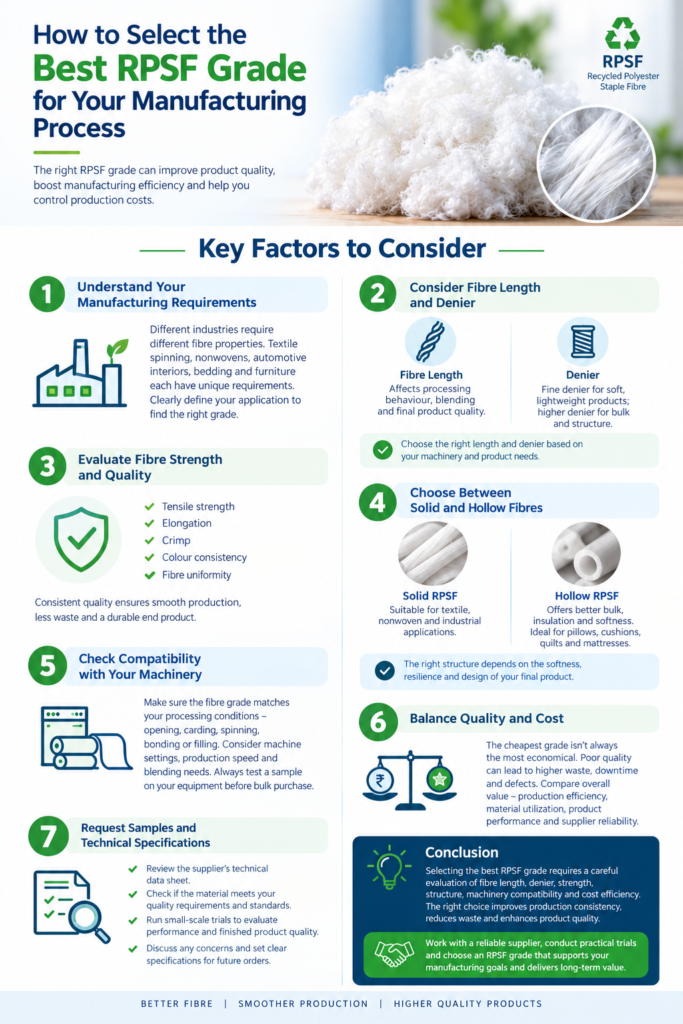
Businesses that want to use recycled content in their products need to select the right RPSF supplier. Fibre quality, consistency, denier, cut length, colour and processing characteristics can all affect how the final product performs.
Also Read: RPSF manufacturer in morbi gujarat what makes rakshitam ecofibre different from other suppliers
So what is RPSF used for? Its applications extend much beyond clothing and textiles. Several industries across India use recycled polyester staple fibre, ranging from automotive interiors, mattresses, nonwovens, furniture, geotextiles, and technical textiles.
As manufacturers continue to look for efficient and more sustainable material solutions, RPSF is likely to be an important part of India’s growing recycled-materials ecosystem.